Perfect Sourdough Focaccia Recipe: Best Easy Rosemary Bread
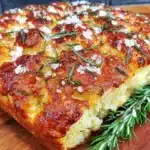
This easy sourdough focaccia recipe produces a golden, crispy crust with a pillowy interior full of air pockets. Made with simple ingredients and minimal active work, it’s perfect for any occasion and always a crowd-pleaser.
- Prep Time: 15 minutes
- Cook Time: 30 minutes
- Total Time: 12 hours 45 minutes (includes overnight proofing)
- Yield: 8 servings 1x
- Category: Bread
- Cuisine: Italian
Ingredients
Scale
- 500 grams (about 4 cups) bread flour
- 150 grams (about ¾ cup) active sourdough starter
- 400 grams (about 1¾ cups) warm water (80°F / 27°C)
- 60 grams (about ¼ cup) extra-virgin olive oil, plus more for the pan
- 10 grams (about 2 teaspoons) fine sea salt
- 2–3 sprigs fresh rosemary, leaves removed and roughly chopped
- 1 tablespoon flaky sea salt (such as Maldon)
- 2–3 tablespoons extra-virgin olive oil for drizzling
Instructions
- Mix the dough: In a large mixing bowl, combine 400 grams of warm water with 150 grams of active sourdough starter. Stir until the starter is mostly dissolved. Add 500 grams of bread flour and mix with your hands or a dough whisk until no dry flour remains. The dough will be shaggy and sticky. Cover the bowl with plastic wrap or a damp towel and let it rest for 30 minutes (autolyse).
- Add the salt and oil: After the rest, sprinkle 10 grams of fine sea salt over the dough and drizzle in 60 grams of olive oil. Use your fingers to pinch and squeeze the salt and oil into the dough until evenly incorporated.
- Stretch and fold: With wet hands, grab one side of the dough, stretch it up as far as it will go without tearing, and fold it over the top. Rotate the bowl a quarter turn and repeat. Do this four times total. Cover the bowl and let it rest for 30 minutes.
- Repeat the stretch and fold: Do another round of four stretch-and-folds, again with wet hands. Cover and rest for 30 minutes. Repeat this process a total of 4-6 times over the next 2-3 hours. By the last round, the dough should feel smoother, stronger, and more elastic.
- Cold proof overnight: After the final stretch and fold, cover the bowl tightly with plastic wrap and place it in the refrigerator. Let it ferment slowly for 12-18 hours.
- Prepare your pan: The next morning, pour about 2 tablespoons of olive oil into a 9×13-inch baking pan. Use your fingers to spread it all over the bottom and sides.
- Transfer the dough: Gently coax the cold dough out of the bowl and into the oiled pan. Don’t try to stretch it to the edges yet—just place it in the center.
- Let it warm up and relax: Cover the pan with plastic wrap or a damp towel and let it sit at room temperature for 1 hour. After an hour, use your fingertips to gently press the dough toward the edges of the pan. If it resists, let it rest another 30 minutes and try again.
- Final proof: Once the dough is evenly spread in the pan, cover it again and let it proof at room temperature for 2-3 hours, or until it looks puffy and has nearly doubled in height.
- Dimple the dough: Generously drizzle 2-3 tablespoons of olive oil over the surface of the dough. Then, using your fingertips, press straight down into the dough to create deep dimples across the entire surface.
- Add the toppings: Sprinkle the chopped fresh rosemary evenly over the dimpled surface. Finish with a generous sprinkle of flaky sea salt—about 1 tablespoon.
- Bake: Place the pan in a cold oven, then set the temperature to 425°F (218°C). Bake for 25-30 minutes, until the top is deep golden brown and the edges look crispy and caramelized.
- Cool: Remove the pan from the oven and let the focaccia cool in the pan for 5 minutes. Then transfer it to a wire rack to cool for at least 15 minutes before cutting.
Notes
Use a young starter (fed 4-6 hours before mixing) for best results. Don’t skip the stretch and folds—they build gluten structure. Wet hands make handling sticky dough easier. Trust visual cues over strict times. Let the focaccia cool properly before cutting to avoid a gummy interior.
Nutrition
- Serving Size: 1/8 of recipe
- Calories: 280
- Sodium: 480
- Fat: 12
- Saturated Fat: 1.5
- Carbohydrates: 38
- Fiber: 2
- Protein: 7
Keywords: sourdough focaccia, easy focaccia, rosemary bread, sourdough bread, homemade bread, Italian bread